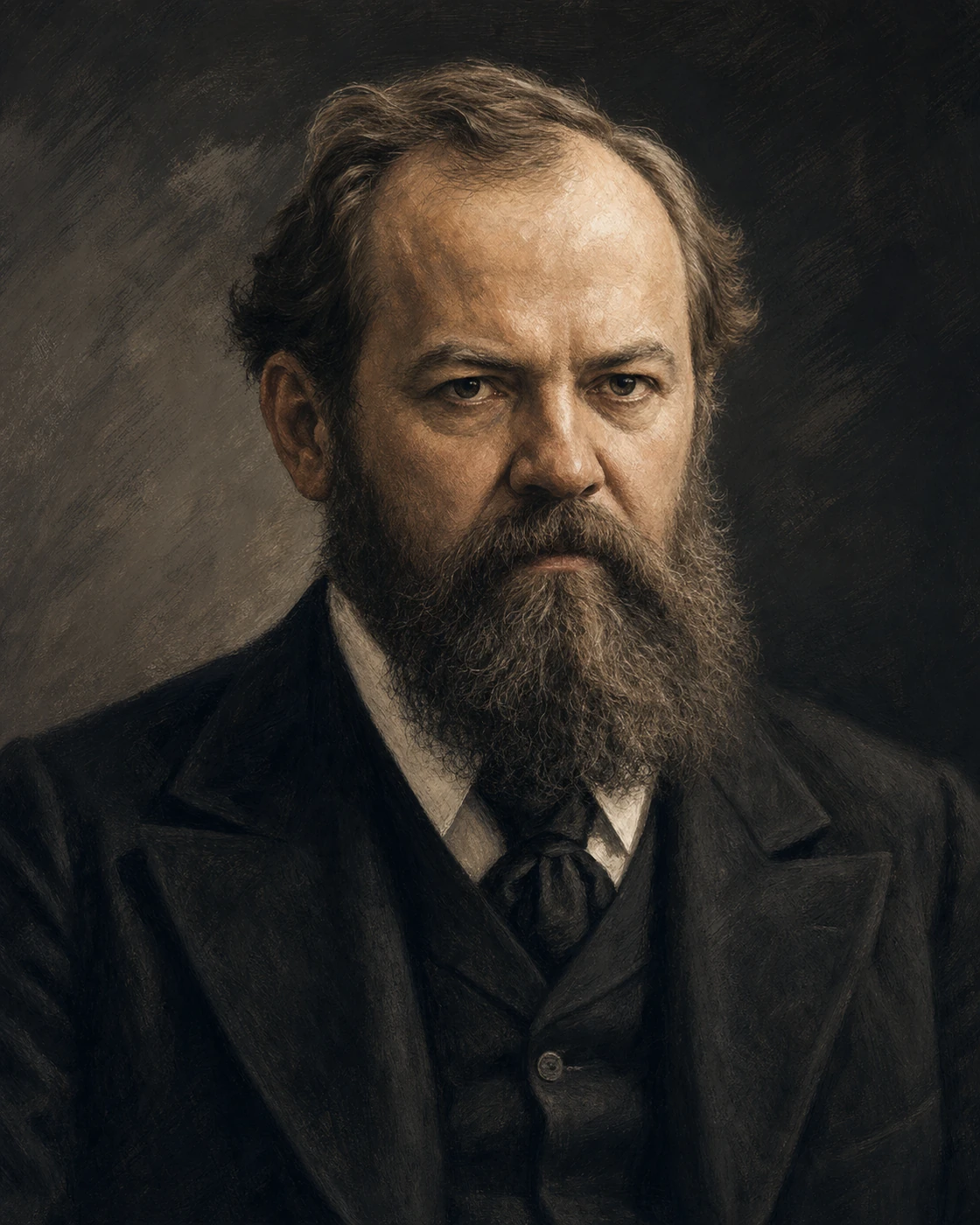
Wilhelm Steinitz
Small advantages
The beginning of modern strategy
The key lesson
Collect small benefits: a better square, a healthier pawn structure and a more active piece. Only their sum justifies an attack.
The bot is a fictional character inspired by the idea of the play, not a digital copy of the master.
Play the idea
Find the master's move
Turn a small positional advantage into a concrete result. Find the move that creates zugzwang.
Select a pawn or piece, then the destination square.
Short answer
Who was Wilhelm Steinitz?
Wilhelm Steinitz was the first official world chess champion, winning the title in a match against Johannes Zukertort in 1886. At first he played romantically and attacked, but later he formulated the foundations of modern strategy: an advantage has to be justified, accumulated and only then turned into an attack.
How did Wilhelm Steinitz play?
Steinitz stressed the importance of the lasting features of a position: pawn structure, weak squares, the bishop pair, space and king safety. He defended positions that his contemporaries considered dangerous, because he believed an attack without an advantage should be repelled. At the same time he could attack very concretely when he had gathered sufficient grounds. For a student this is the foundation of evaluation: a plan does not start with a liking for attack or defense, but with the differences on the board.
What can you learn from the games of Wilhelm Steinitz?
- Name at least two lasting advantages before you start an irreversible pawn attack in front of your own king.
- If your opponent attacks without preparation, trade the active pieces and close lines instead of defending every point separately.
- Accumulate small advantages, but control the moment of the breakthrough. An advantage you do not use can vanish after a single exchange.
Why is Wilhelm Steinitz important in chess history?
Steinitz changed the way chess is described. Instead of treating a combination as proof of genius detached from the position, he looked for principles explaining when an attack is justified. His ideas were later developed and corrected, but the foundation remained: evaluate the position, accumulate advantages, restrict counterplay and only then act concretely.
Next
Rivals and contemporaries
Next master
Sources and scope
Biographical facts were checked against: FIDE: world champions. The description of the style, the training tips and the exercise are Szachmaty's own educational work. They are not a copy of a book or a record of the master's statements. See also how we make the project.
The portrait is a labeled illustration and does not suggest cooperation with or authorization by this person. Last updated: .